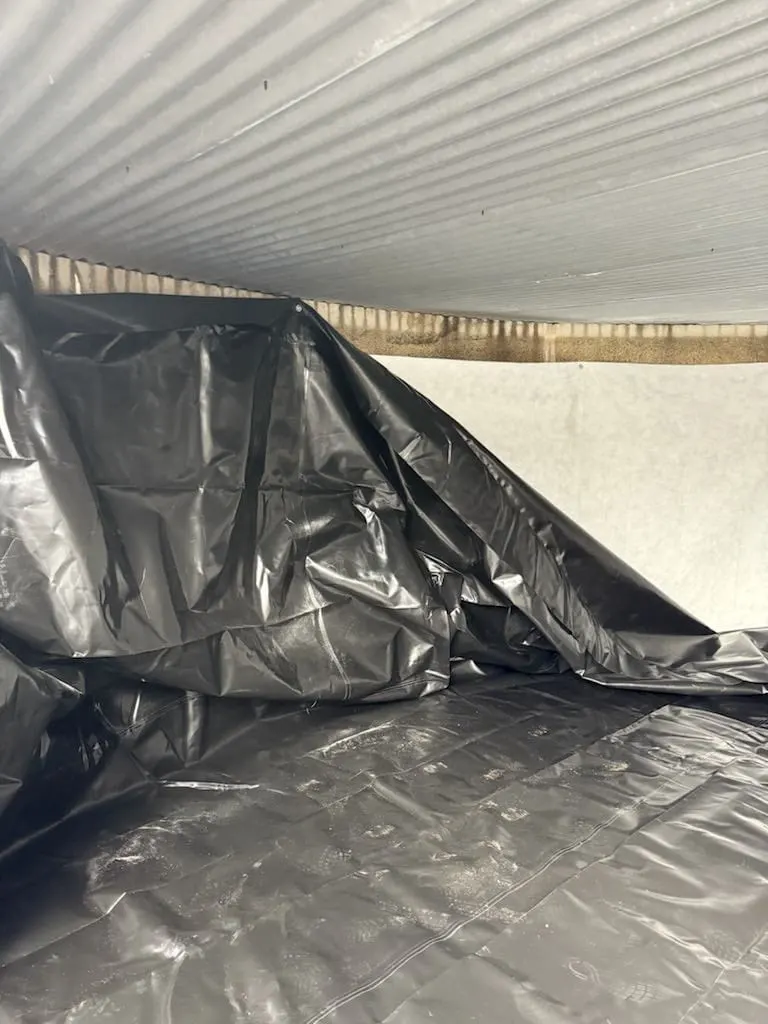
Concrete tank liners
STOP A CONCRETE TANK LEAKING, WITHOUT REBUILDING IT
A fitted liner seals the whole inside face of the tank at once. It is faster and cheaper than chasing cracks with render or sealant.
Short answer
How do you fix a leaking concrete water tank?
Drain the tank, clean the wall and base, then fit a potable grade liner over geo-textile matting. The liner seals every crack and joint at once, so the tank holds water again without a rebuild. Most tanks are back in service the same day.
The work
What we do, and why
What fails in a concrete tank
Concrete tanks fail from movement, not from wear. The wall and base flex with ground movement, heat and the weight of the water. That opens hairline cracks at the wall to base joint first, then up the wall.
Common causes we find: - Ground movement and settling under the base - Tree roots lifting or splitting the base slab - Old render or bitumen coatings that have gone brittle and lifted - Rusted or slack bands letting the wall spread - Poorly sealed outlet and inlet penetrations
How the leak is diagnosed
We start with a drop test. You mark the water line and leave the tank alone for 24 hours with the outlets shut. A drop with no use points at the tank, not the plumbing.
On site we drain the tank and clean the wall. Cracks show as damp lines that dry last. We also check the outside for wet patches and the base for movement. If the wall itself has spread, bands are fixed before any liner goes in. There is no point lining a tank that is still moving.
How the repair is done
The tank is drained and cleaned back to sound concrete. Loose render, old coatings and sharp edges are removed. Any hole or step that would push through the liner is patched.
Geo-textile matting is fitted to the wall and base. It is a cushion. It keeps grit, cracks and rough concrete off the liner, which is what makes the difference between a liner that lasts fifteen years and one that fails in three.
The liner is then custom made for the tank diameter and height, dropped in, fitted to the wall and sealed at the top edge. Outlets, inlets and overflows are cut and installed. The job is finished the same day. We do not wait for the tank to fill.
What drives the cost
Cost is driven by diameter first, then by access, the condition of the shell and how far we have to travel.
We do not publish rates, because no two tanks are the same. Every job is quoted firm after inspection, and the written quote is the price you pay.
How long it takes
Most concrete tanks are lined the same day on site, once drained. Draining is the slow part and it is usually done by you before we arrive, so plan your water supply around it.
Metro jobs generally start within a week of you accepting the quote. Regional jobs are batched by area, so lead time depends on where you are. Ask when you call and we will give you a real date, not a guess.
What warranty applies
Workmanship is warranted by us. The liner material carries the manufacturer warranty for the grade supplied. Both are written on the quote before you accept, so you can read the terms while you are still deciding.
Warranty does not cover damage from things we told you to fix and you chose not to, such as termite damage, rusty panels or no bands installed.
Specifications
CONCRETE LINER SPECIFICATIONS
Typical figures. Your tank is measured on site before anything is ordered.
| Item | Detail |
|---|---|
| Tank diameters served | 3 m to 25 m |
| Typical liner life | 15 to 20 years with matting fitted |
| Liner material | Potable grade PVC or polyethylene |
| Backing | Geo-textile matting to wall and base |
| Time on site | The same day once the tank is drained |
| Turnaround, Perth metro | Usually within a week of quote acceptance |
| Turnaround, regional WA | Batched by region, ask when you call |
Concrete liners
ASKED ON EVERY CONCRETE JOB
Still stuck? Call 0499 142 149.
No. The wall and base have to be dry and clean for the matting and liner to sit properly. Plan the drawdown so you still have water while the job runs.
For most tanks, yes. Patching seals the crack you can see. A liner seals the whole inside face, including the cracks that have not opened yet.
Yes, when a potable grade liner is used. Tell us the tank is for drinking water and we will spec it that way.
If the tank needs new bands because of large cracks, or the old bands are worn, yes, and new bands go on before the liner. A moving wall will work the liner and shorten its life. We check the bands as part of the inspection.
Related
BEFORE YOU BOOK
Get a price
SEND US THE NUMBERS.
Diameter, height, outlets and a couple of photos. That's usually all we need to come back with a firm price. No site visit is needed to start.
Coverage
WE TRAVEL FOR TANKS
WA Tanks is based in Perth and works across Western Australia. We cover the Perth metro area, the South West, the Wheatbelt, the Mid West, the Great Southern and the Goldfields. Regional jobs are batched into runs, so the lead time depends on the next trip to your area.
Not on the list? Call, we usually travel there anyway.
Perth metro
Perth & HillsSwan ValleyRockinghamMandurahBullsbrookChitteringMetro jobs usually start within a week of the quote being accepted.
South West
BunburyBusseltonMargaret RiverManjimupBooked into the next South West run, so timing follows the run, not the call.
Wheatbelt
NorthamMerredinNarroginBooked into the next Wheatbelt run, so timing follows the run, not the call.